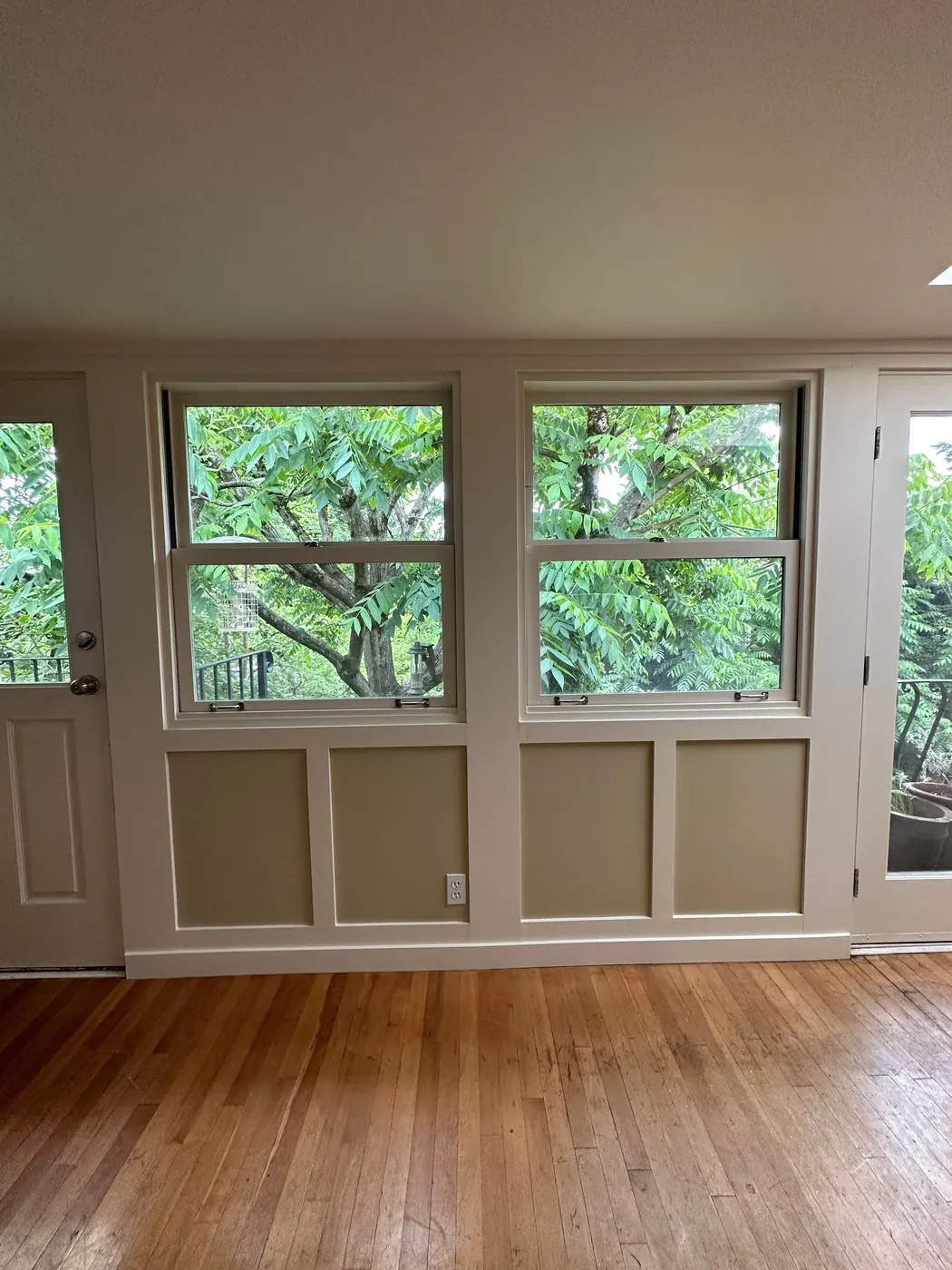
Interior house painting is the preparation and coating of a home's interior surfaces - walls, ceilings, trim, doors, stairs and built-ins - to protect them and change how a room looks and feels. In a professional job, most of the work happens before the paint goes on: repairs, sanding, caulking, priming and protecting floors and furniture. The coating itself is usually two finish coats of a waterborne acrylic paint.
In Vancouver, interior painting comes with local conditions. More than half the city's homes were built in 1990 or earlier, so lead paint and asbestos-containing materials are a real consideration. Most homes are apartments governed by strata rules. And the city's damp winters make bathroom moisture and mildew a recurring problem.
This guide draws on federal and provincial regulations, manufacturer technical data, Statistics Canada figures and our own job files. Renaissance Painting & Carpentry has painted Vancouver homes since 1992, and the "From our job files" notes below come from the written scopes we have kept since 2017.
Interior house painting at a glance
- What it covers
- Walls, ceilings, trim, doors, stairs, cabinets and the prep and repairs behind them
- Standard system
- Prep, primer where needed, 2 finish coats
- Typical paint
- 100% acrylic waterborne, titanium dioxide pigment
- Coverage
- About 400-450 sq ft per US gallon per coat (premium acrylic)
- Minimum temperature
- 10 °C (50 °F) for latex
- Canada VOC limit
- 100 g/L flat, 150 g/L non-flat
- Lead limit in new paint
- 90 mg/kg (dry film)
- Vancouver homes built in 1990 or earlier
- 54.8% (2021 Census)
- Published Vancouver price range
- About $3-$8 per sq ft of floor area, full interior
- Our experience
- 794 projects since 1992
Table of Contents
- What interior house painting includes
- A short history: from lead to low-VOC
- Why Vancouver interiors are different
- How much interior painting costs
- Paint types and what is in the can
- Sheen levels and where to use them
- VOC rules in Canada
- Lead paint and asbestos in older homes
- The professional process, step by step
- What "properly painted" means
- Bathrooms, moisture and mildew
- Colour: 2026 trends and light
- Common interior paint problems
- Leftover paint and recycling in BC
- DIY or hire a painter
- Frequently asked questions
What interior house painting includes
Interior painting covers every painted surface inside the building envelope. The term usually means repainting existing finishes rather than painting new construction, and the scope varies far more than most homeowners expect.
To show what a real interior job contains, we went through the interior scopes of work in our own proposal files. Each line counts how many of those jobs included that surface or task.
| Surface or task | Jobs that included it | Share of jobs |
|---|---|---|
| Ceilings | 105 | 65% |
| Trim (casings, window trim) | 77 | 48% |
| Doors | 70 | 43% |
| Kitchens | 49 | 30% |
| Baseboards | 49 | 30% |
| Stairs and stairwells | 42 | 26% |
| Bathrooms | 40 | 25% |
| Drywall repair | 35 | 22% |
| Crown moulding | 16 | 10% |
| Textured (popcorn) ceilings | 10 | 6% |
| Wallpaper | 5 | 3% |
Method: interior proposals written by Renaissance Painting & Carpentry for Vancouver-area homes, 2017-2026, that had a written scope of work (n=161). Walls appear in nearly every scope and are not listed. Counts include only what the scope named. No client or price data is used.
Two things stand out. First, ceilings are in about two of every three jobs, so "just the walls" is rarely the whole picture. Second, about one job in five involves drywall repair before painting. A painter who can also fix drywall and trim saves you a second trade. That is one reason we keep drywall repair and trim carpentry in-house.
A short history: from lead to low-VOC
House paint has changed more in the last 70 years than in the previous several centuries. For a homeowner, the two changes that matter most are the end of lead and the move to low-VOC waterborne coatings.
- Before 1950: According to Health Canada, paints made before 1950 contained large amounts of lead. Some 1940s paint was up to half lead by dry weight.
- 1976: A federal rule banned paint containing more than 0.5% lead.
- 1992 onward: Health Canada considers consumer paint made in Canada or the US for indoor use since 1992 to be virtually lead-free.
- 2009: Canada's VOC limits for architectural coatings were registered (SOR/2009-264).
- 2010: The lead limit for surface coatings dropped to 90 mg/kg, the level that applies today.
The VOC rule had a measurable effect. Environment and Climate Change Canada survey data shows VOC emissions from architectural coatings fell from 74.7 kilotonnes in 2002 to 11.7 kilotonnes in 2018, while the volume of paint sold stayed roughly the same (about 293 and 283 million litres). That is a cut of about 84% at nearly constant volume.
Why Vancouver interiors are different
An older housing stock
The age of a home decides how much prep a painter has to do and whether hazardous materials are a concern. In the City of Vancouver, more than half of occupied homes predate 1991.
| Built | Dwellings | Share | What it means for painting |
|---|---|---|---|
| 1960 or earlier | 62,225 | 20.4% | Probably contains lead paint; plaster walls common |
| 1961-1980 | 69,110 | 22.6% | Possible lead in older layers; textured ceilings common |
| 1981-1990 | 35,990 | 11.8% | Asbestos still possible in texture and drywall compound |
| Total, 1990 or earlier | 167,325 | 54.8% | Treat as suspect before sanding or scraping |
Source: Statistics Canada, 2021 Census Profile, City of Vancouver (305,335 occupied private dwellings).
Mostly apartments, mostly strata
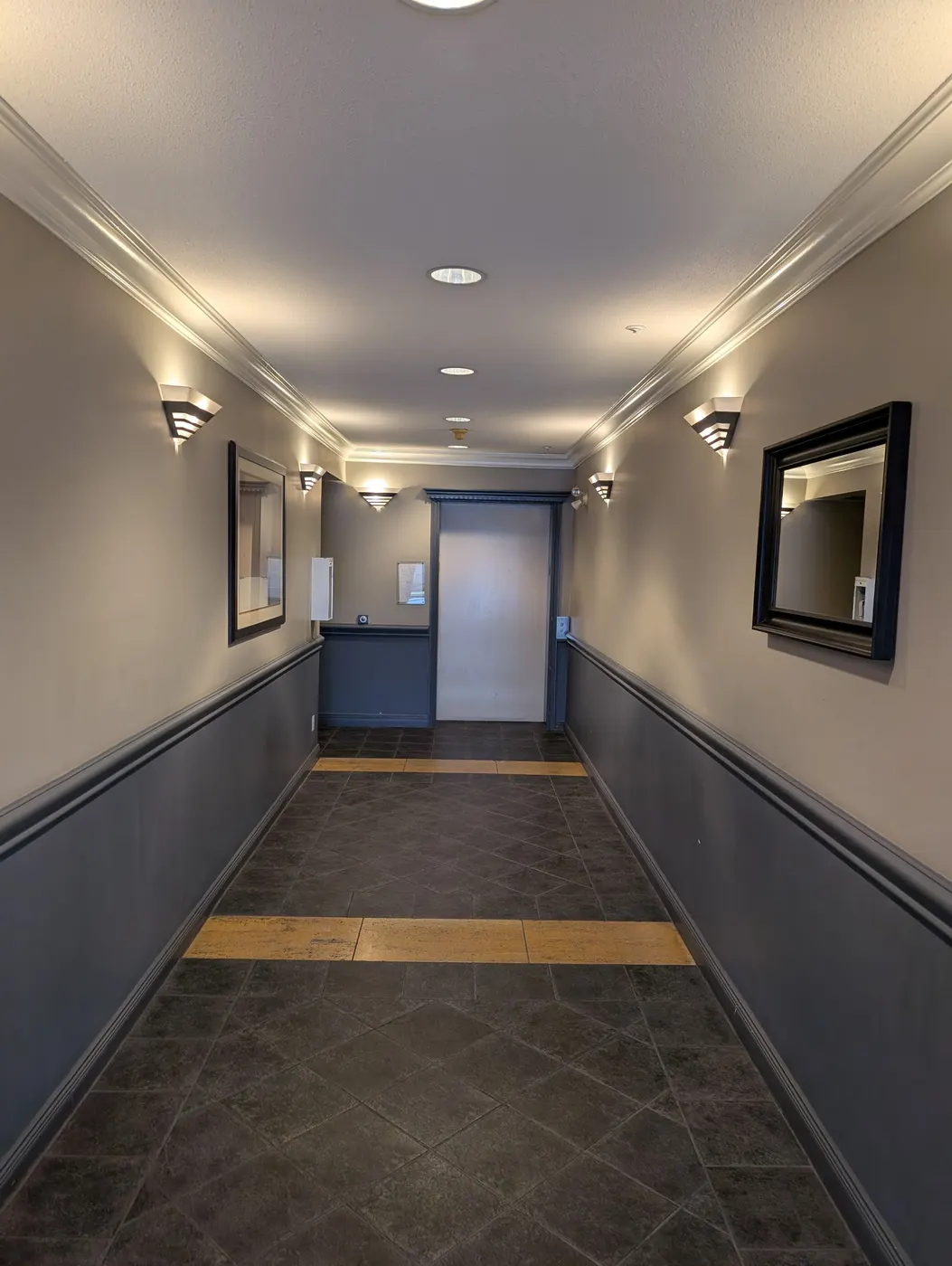
Single-detached houses are only 14.7% of homes in the City of Vancouver (44,755 dwellings, 2021 Census). Most interior jobs here happen in condos and townhouses, where the strata sets the rules. Expect limits on work hours and noise, elevator bookings, parking permits and sometimes the colours and sheens allowed in common areas. We confirm these with the building manager before we schedule. See our strata painting page for how we work in occupied buildings.
Where we work
Across all our proposals that carry a postcode (n=632), the most common neighbourhoods are Kitsilano (26%), West Point Grey (16%), Mount Pleasant (9.5%), Riley Park (6%), Kerrisdale (5%), South Cambie (4%), and Dunbar-Southlands and North Vancouver (about 4% each). We also work in Shaughnessy, Fairview, the West End, Arbutus Ridge, Kensington-Cedar Cottage, West Vancouver, Burnaby, New Westminster, Coquitlam, Port Moody and Maple Ridge. These are mostly older neighbourhoods, which is why prep and hazmat awareness get so much space in this guide.
A damp climate
Vancouver's long wet season keeps indoor humidity high, especially in bathrooms, basements and older homes with single-glazed windows. That affects drying times, mildew and paint adhesion. The good news is that rain does not stop interior work. As long as rooms stay heated, winter is a practical time to paint indoors. More on this in our guide to interior painting temperature.
How much interior painting costs
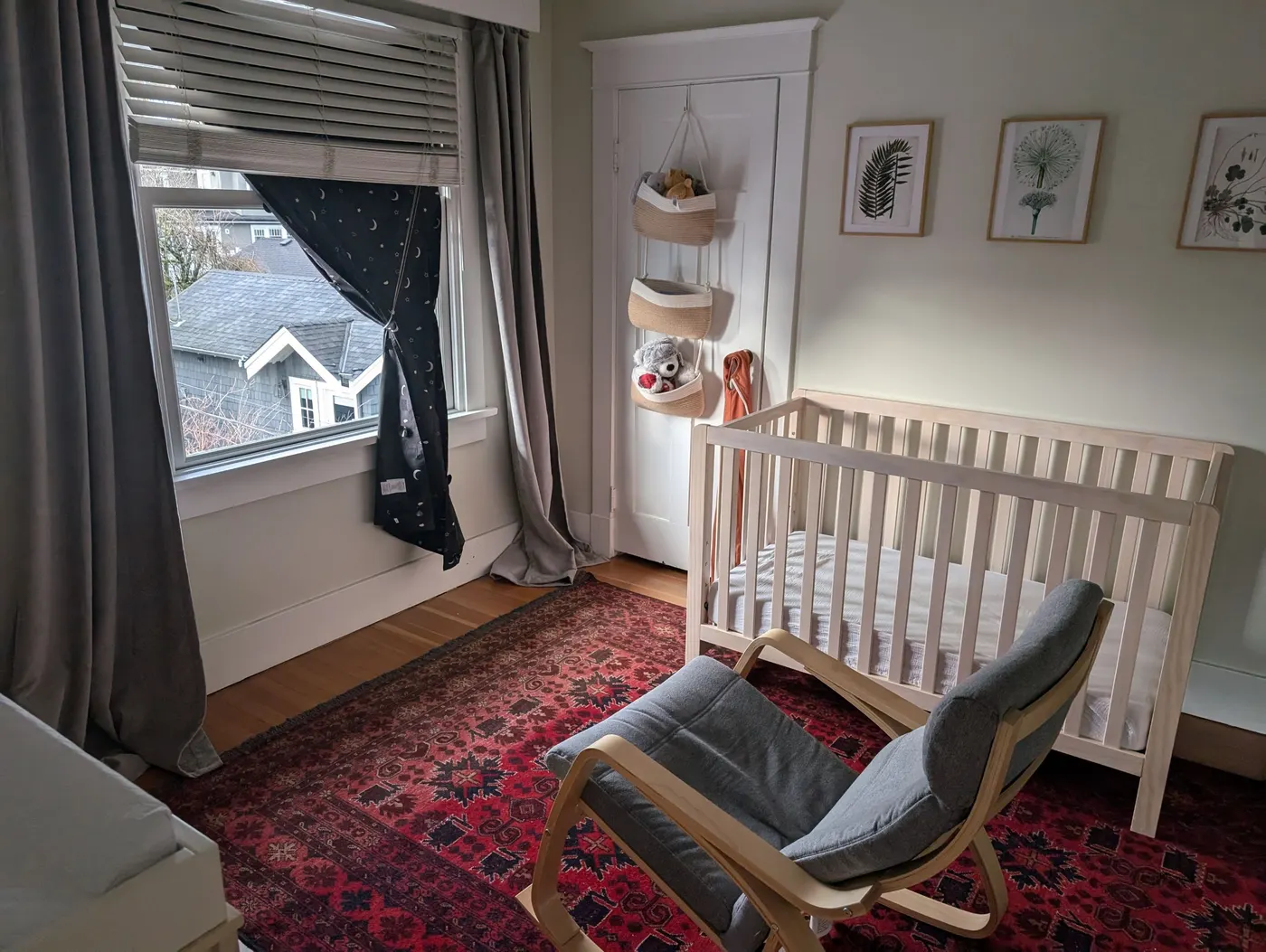
Published Vancouver price guides for 2026 put a full interior (walls, ceilings and trim) at roughly $3 to $8 per square foot of floor area, and walls only at about $2 to $5.50 per square foot. Those same guides list about $600-$1,200 for a single bedroom, $3,500-$5,500 for a two-bedroom condo, and $8,000-$15,000 or more for a 2,000 sq ft house. They are contractor marketing figures, not audited data, so treat them as a starting range.
| Job | Published range | Main price drivers |
|---|---|---|
| Walls only | $2-$5.50 per sq ft | Wall condition, colour change |
| Full interior (walls, ceilings, trim) | $3-$8 per sq ft of floor | Ceiling height, amount of trim and doors |
| Single bedroom | $600-$1,200 | Closets, ceiling, trim included or not |
| Two-bedroom condo | $3,500-$5,500 | Strata logistics, occupied or empty |
| 2,000 sq ft house | $8,000-$15,000+ | Stairwells, repairs, number of colours |
Our own projects start at $1,050, and every job gets a fixed written price with the scope spelled out. For a quick number for your home, try our interior painting cost calculator.
What moves the price
Labour is most of the cost of an interior job, so anything that adds hours adds money. In our experience these are the factors that change a quote the most:
- Prep and repairs. Cracks, dents, nail pops and old patches all need filling, sanding and spot priming.
- Colour change. Going from a dark colour (navy, forest green, deep red) to white can take three or four coats instead of two. Tell us your colours before we quote and the number holds.
- Ceilings and stairwells. High or vaulted ceilings and open stairwells need extra setup.
- Trim, doors and cabinets. These are brushed by hand and take far longer per square foot than walls. More in our interior door painting cost guide.
- Occupied homes. Moving and protecting furniture, and working around a household, adds time.
- Hidden conditions. A textured ceiling assumed to be asbestos-free that tests positive, wallpaper of unknown type, or damage hidden behind furniture.
The price changes after the quote only if the scope changes, and you hear about it before any extra work starts.
Paint types and what is in the can
Every paint has four parts: a binder that forms the film, pigment for colour and hiding, a liquid carrier (water or solvent) that evaporates, and additives for flow, mildew resistance and durability. Premium interior wall paint today is waterborne, with a 100% acrylic binder and titanium dioxide as the main white pigment.
| Type | Typical use | Strengths | Trade-offs |
|---|---|---|---|
| 100% acrylic latex (waterborne) | Walls, ceilings | Low odour, fast drying, flexible, easy clean-up | Less hard than enamels on high-wear trim |
| Waterborne alkyd / urethane-modified enamel | Trim, doors, cabinets | Hard, smooth, levels like oil without solvent odour | Longer recoat times, needs careful prep |
| Solvent-borne alkyd (oil) | Rarely, for specific repairs | Very hard film, strong adhesion to old oil paint | Strong odour, higher VOC, yellows over time |
| Pre-catalyzed waterborne epoxy | Wet rooms, high-moisture areas | Moisture and scrub resistance | Specialist product, more expensive |
| Waterborne lacquer | Kitchen cabinets | Fast-curing, furniture-like finish | Usually sprayed, needs a controlled setup |
An important prep detail: latex paint does not bond well straight over old oil-based paint. Older Vancouver homes often have oil on trim and doors, so we test and prime those surfaces before painting. You can read more in our article on latex vs acrylic paint.
How a premium wall paint performs
Manufacturer technical data sheets give the numbers painters plan with. Here is what Benjamin Moore's Regal Select data sheet specifies, one of the wall paints we use most often:
| Property | Value |
|---|---|
| Binder | 100% acrylic |
| Coverage | 400-450 sq ft per US gallon (about 37-42 m² per 3.78 L can) |
| Volume solids | 37-46%, depending on sheen |
| Dry to touch | About 1 hour at 25 °C and 50% RH |
| Recoat | 1-2 hours (longer for some semi-gloss versions) |
| Application temperature | Not below 10 °C (50 °F) air or surface |
| Washable | After about two weeks of curing |
Real coverage is usually lower than the label. Rough or porous surfaces, fresh patches and big colour changes all use more paint.
What we specify, from our job files
- Walls: Benjamin Moore Regal or Sherwin-Williams Duration (matte or washable flat)
- Trim and doors: Benjamin Moore Advance, a waterborne alkyd enamel
- Wet rooms: Sherwin-Williams Pro Industrial pre-catalyzed waterborne epoxy
- Cabinets: Sherwin-Williams Kem Aqua waterborne lacquer
- The whites clients pick most: Chantilly Lace, Cloud White and Dove White (all Benjamin Moore)
Sheen levels and where to use them
Sheen is how much light a dried paint film reflects. It is measured in gloss units with a glossmeter at a 60° angle, and low sheens are also measured at 85° (called "sheen"). The industry reference in Canada is the Master Painters Institute (MPI) scale of seven gloss levels.
| MPI level | Name | Gloss at 60° | Sheen at 85° | Common interior use |
|---|---|---|---|---|
| G1 | Matte / flat | 0-5 | 10 or less | Ceilings, low-traffic walls |
| G2 | Velvet | 0-10 | 10-35 | Living rooms, bedrooms |
| G3 | Eggshell | 10-25 | 10-35 | Most walls, hallways |
| G4 | Satin | 20-35 | 35 or more | Kitchens, kids' rooms, bathrooms |
| G5 | Semi-gloss | 35-70 | - | Doors, trim, cabinets |
| G6 | Gloss | 70-85 | - | Trim and furniture accents |
| G7 | High gloss | Over 85 | - | Specialty finishes |
Gloss ranges from the MPI guide specification (April 2022). Canada's VOC regulation uses its own legal definition: "flat" means below 15 units at 85° or below 5 at 60°.
The rule of thumb: the higher the sheen, the easier it is to clean, and the more it shows every flaw in the wall. Flat finishes hide imperfections and are best on ceilings. Our usual default is flat on ceilings, a washable matte or eggshell on walls, and satin or semi-gloss on trim and doors. MPI's own specification defaults to semi-gloss for doors, frames and trim.
VOC rules in Canada
Canada caps flat interior paint at 100 grams of VOC per litre and non-flat paint at 150 g/L. Volatile organic compounds (VOCs) are carbon-based chemicals that evaporate as paint dries. They contribute to smog outdoors and to odour and indoor air pollution while a room is being painted.
| Category | Current limit | Proposed limit (2022 consultation) |
|---|---|---|
| Flat coating (general) | 100 g/L | 50 g/L |
| Non-flat coating (general) | 150 g/L | 50 g/L |
| Primer, sealer, undercoater (general) | 200 g/L | - |
| All 53 categories | 100-800 g/L | - |
Source: Volatile Organic Compound (VOC) Concentration Limits for Architectural Coatings Regulations, current to September 2026, last amended June 2019; Environment and Climate Change Canada consultation on amendments.
- Proposed, not in force. Environment and Climate Change Canada consulted on tighter limits from October 2022 to January 2023, aligned with California-style rules. As of late 2026, the consolidated regulation still shows no amendment after 2019.
- Tint can add VOC. Colourant added at the store is not counted in the base paint's VOC figure, so deep colours can carry more VOC than the label shows.
- Stricter than the US federal rule. The US EPA limit for interior flat coatings is 250 g/L, although some California air districts set 50 g/L.
- Health advice. Health Canada says most VOC levels in Canadian homes are not a significant health risk, lists paint as an indoor source, and recommends extra ventilation. HealthLinkBC advises choosing paints labelled low-VOC and opening windows after painting.
Many premium paints now sit well under the legal limits. The Regal Select data sheets list under 50 g/L for eggshell and close to zero for some versions.
Lead paint and asbestos in older homes
Lead
A Vancouver home built before 1960 probably contains lead-based paint somewhere under the current layers. That is Health Canada's guidance. HealthLinkBC adds that interior and exterior paint from 1960 to 1990 may also contain smaller amounts of lead.
- New paint sold in Canada may not contain more than 90 mg/kg of total lead in the dried film, under the Surface Coating Materials Regulations.
- Health Canada advises against using power sanders, heat guns or blowtorches to remove paint in older homes, because they create lead dust and fumes.
- In BC, WorkSafeBC's OHS Regulation (Part 6) requires an employer to have an exposure control plan, developed by a qualified person, when workers are or may be exposed to lead. The 8-hour exposure limit for inorganic lead is 0.05 mg/m³.
- Canada has no equivalent to the US EPA's Renovation, Repair and Painting (RRP) rule, which requires certified firms for paid work that disturbs paint in pre-1978 US homes.
Intact lead paint under newer coats is not an immediate hazard. The risk comes from dust when it is sanded, scraped or heated. In pre-1960 homes we test before dry sanding, keep sanding to a minimum, use containment and HEPA vacuums, and plan for children and pregnant family members to be out of the work area.
Asbestos
In BC, a hazardous materials survey by a qualified person is required before renovation work that could disturb asbestos. WorkSafeBC's OHS Regulation (section 20.112) puts this duty on owners and employers, and WorkSafeBC has stated that homeowners must get their homes tested before renovation or demolition. Asbestos can be found in more than 3,000 building materials, including textured "popcorn" ceilings and drywall joint compound.
The regulation does not set a cut-off year. In practice, homes built before 1990 are treated as suspect, and the City of Vancouver uses "built in 1990 or earlier" as its permit trigger. WorkSafeBC reported 1,112 accepted workplace deaths related to asbestos in BC between 2002 and 2021 (WorkSafeBC, October 2022).
From our job files
Textured ceilings were in 6% of our interior scopes. If a ceiling is presumed asbestos-free and then tests positive, the price and the plan change: abatement comes first, by a licensed contractor, and painting follows. That is why we ask for test results, or arrange testing, before we quote on any textured ceiling in a pre-1990 home.
The professional process, step by step
Every Renaissance proposal names the standards we work to: the manufacturer's specifications, the Master Painters Institute Repainting Manual, and the application standards of the Painting Contractors Association (formerly PDCA), including standard P14 for levels of surface preparation. Here is what that looks like in a typical room.
- Walk-through and written scope. We list every surface, the number of coats, the product and sheen for each, and anything excluded.
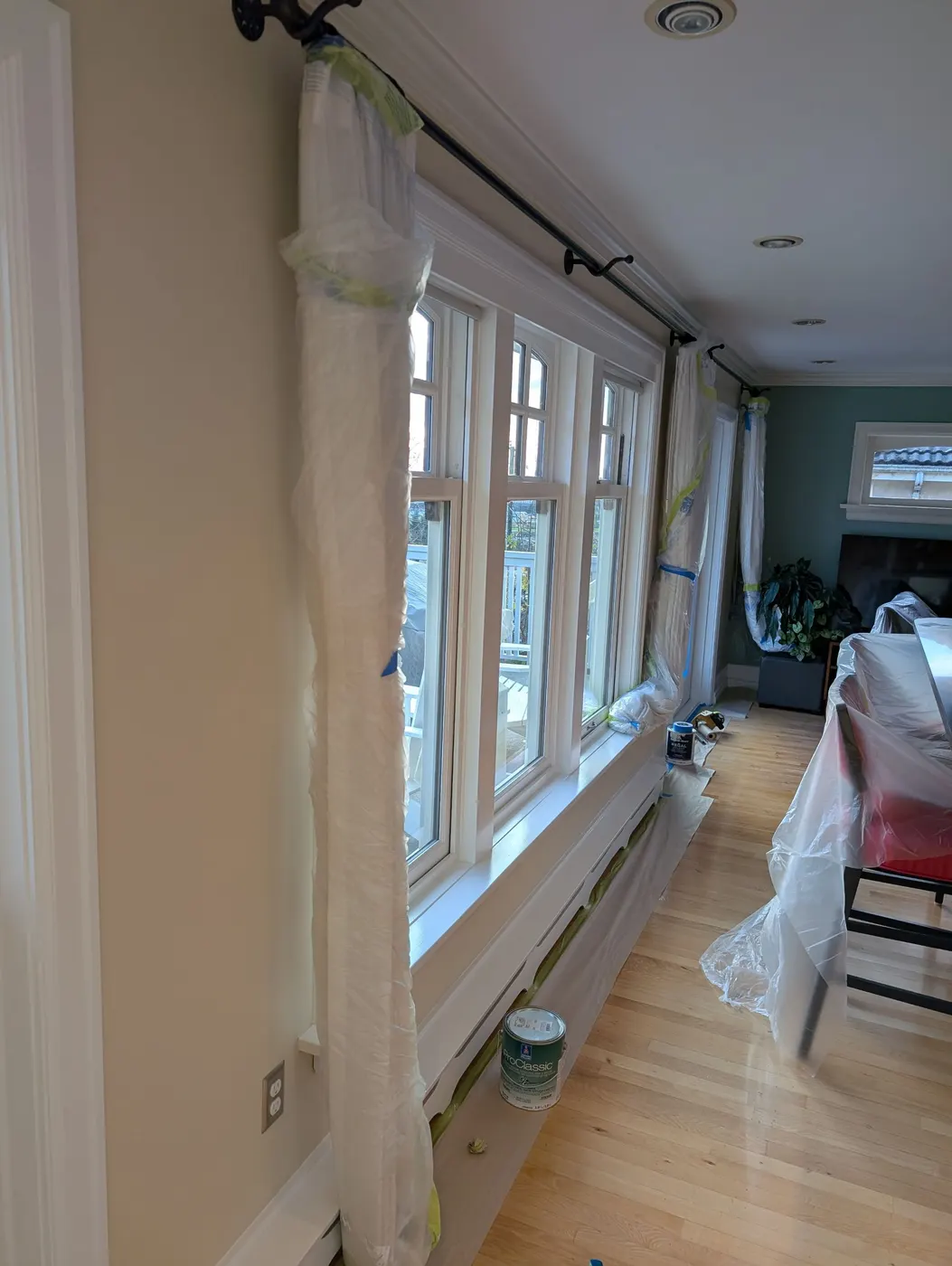
- Protect. Furniture is moved to the centre and covered. Floors are covered, and windows and fixtures are masked.
- Remove hardware. Switch plates, outlet covers, grilles, towel bars and similar fittings come off, and they go back on at the end.
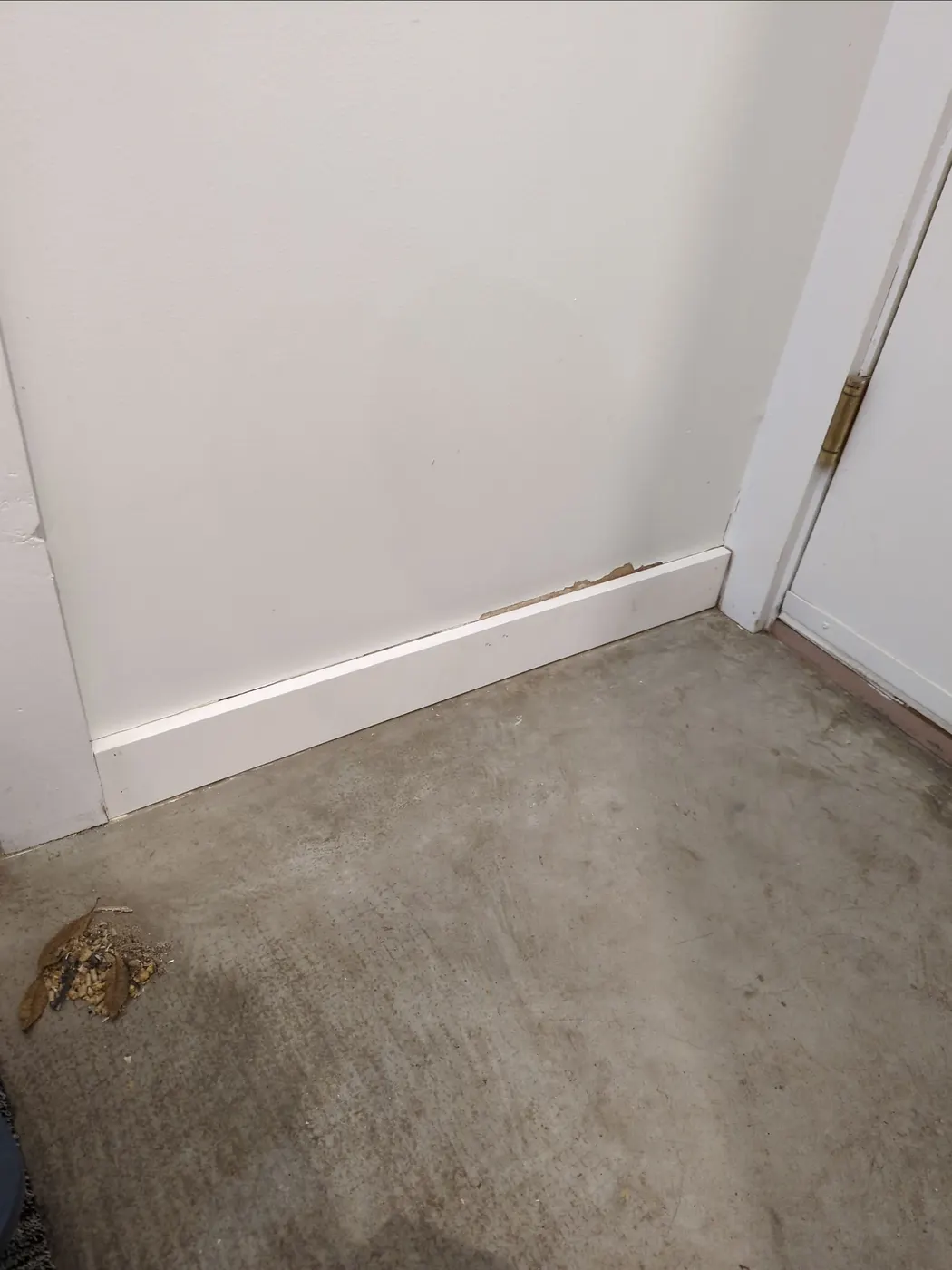
- Repair. Holes and cracks are filled and sanded. Larger drywall damage is patched by our own crew. See what needs fixing before painting.
- Spot prime. Every patch, bare spot and stain gets primer, so the finish coat dries evenly.
- Caulk. Gaps along trim and baseboards are caulked, preferably after priming so the caulk bonds properly.
- Dust off. Trim is wiped down before painting to remove dust that would spoil adhesion.
- Ceilings first, then walls, then trim. Gravity decides the order.
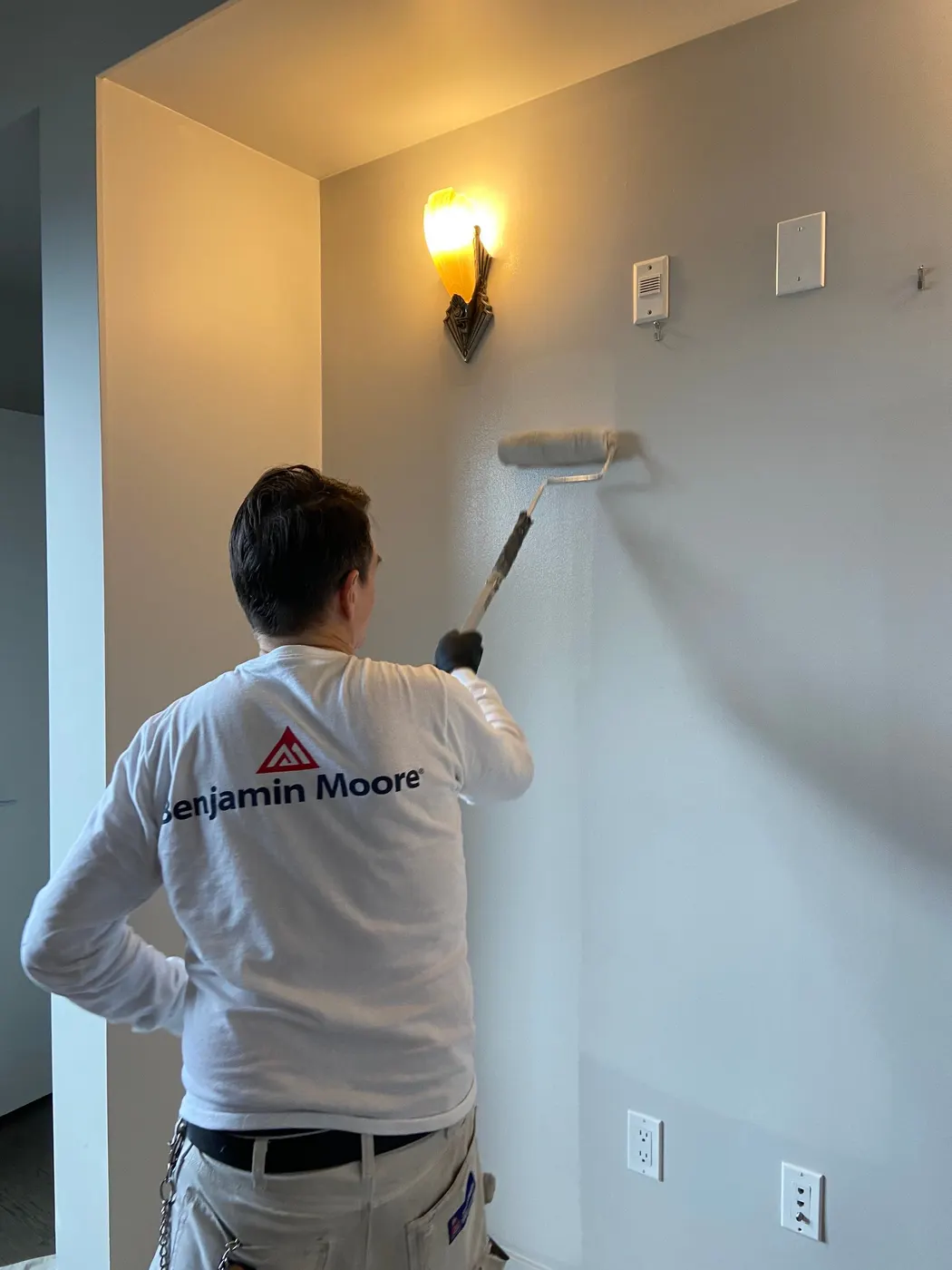
- Two finish coats, with walls lightly pole-sanded between coats using 120-grit paper and trim sanded between coats.
- Final walk-through. We check the work with you under normal lighting, touch up, reinstall hardware and clean up.
| Condition | Limit |
|---|---|
| Latex paint | Not below 10 °C (50 °F) |
| Oil-based paint | Not below 5 °C (40 °F) |
| Relative humidity | No painting above 80% |
| Tools | Purdy 2½" or 3" brushes; 15 mm lint-free roller sleeves for walls and ceilings, 5 mm for trim |
How long it takes
A single room is usually one to two days with prep and two coats. A full condo often takes three to five working days. A whole house can take one to three weeks, depending on repairs, ceilings, trim and stairwells. Our article on how long interior painting takes goes into more detail.
What "properly painted" means
Painting has a written industry definition of a good result. Under the Painting Contractors Association's Standard P1, a properly painted surface is uniform in colour, texture, hiding and sheen, and free of runs, sags, misses, drips, spatters and overspray.
The standard also says how to judge it: viewed without magnification from at least 39 inches (1 metre), under finished lighting, from a normal eye-level position. It is not judged with a flashlight held flat against the wall. Knowing this helps both sides agree on what "done" means before the job starts.
One honest limitation: touch-ups rarely match perfectly. Paint batches vary and older paint fades, so spot repairs can show. When a client asks us to touch up rather than repaint, we say up front that we will minimize the difference, and that a full wall from corner to corner is the only way to guarantee a match.
Bathrooms, moisture and mildew
Bathrooms are where interior paint fails first in Vancouver, and the cause is usually ventilation, not the paint. A typical household releases 10 to 50 litres of moisture into the air every day, according to the CMHC.
- Fans: The BC Building Code (Table 9.32.3.6, 2018 edition) requires a bathroom exhaust fan of at least 23 L/s (about 49 cfm) for intermittent use, or 9 L/s running continuously. Kitchens need 47 L/s.
- Humidity: Health Canada recommends keeping indoor relative humidity between 30% and 50%, and running a dehumidifier when water condenses on cold surfaces such as windows.
- Mould clean-up: Health Canada considers a mould patch up to about 1 m² (10 sq ft) "small". Bigger areas, or mould that keeps coming back, point to a moisture problem that paint will not fix.
Before repainting a bathroom we clean and kill any mildew, let the surface dry, prime stains, and use a moisture-resistant finish. In wet rooms we specify a pre-catalyzed waterborne epoxy. If the fan is weak or missing, we tell you, because paint over a moisture problem will peel again. If paint is already blistering, see how to fix bubbled paint on walls and ceilings.
Colour: 2026 trends and light
Paint makers announce a "colour of the year" each autumn. For 2026, the picks lean warm, earthy and deep:
| Brand | 2026 colour | Character |
|---|---|---|
| Benjamin Moore | Silhouette AF-655 | Rich espresso brown with charcoal notes |
| Sherwin-Williams | Universal Khaki SW 6150 | Warm, earthy khaki |
| Behr | Hidden Gem N430-6A | Smoky jade green |
| Cloverdale Paint (BC) | Day Spa 0634 | Deep blue with aqua undertones |
| Pantone (not a paint) | Cloud Dancer 11-4201 | Soft off-white |
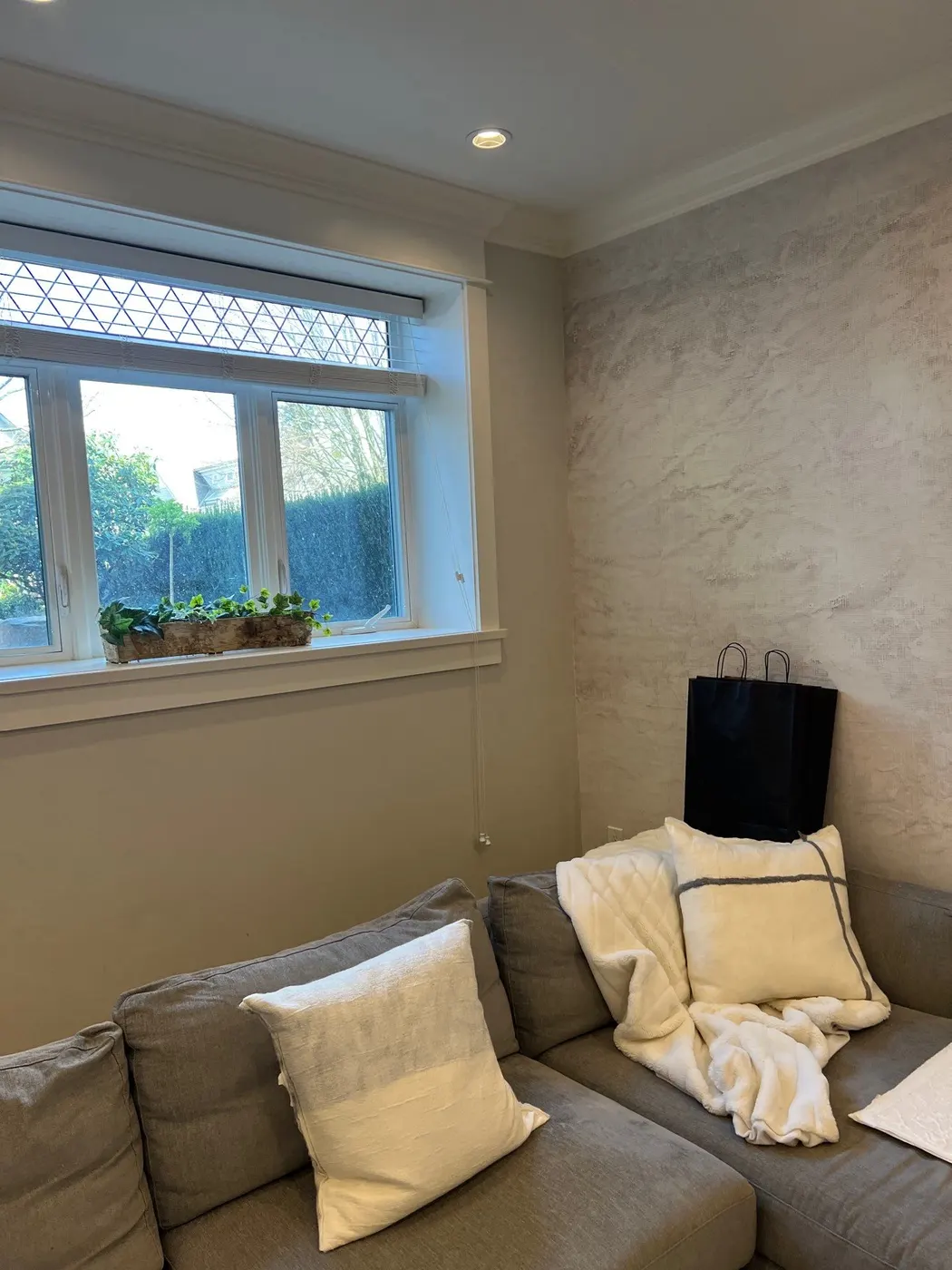
Trends matter less than light. Every colour has a light reflectance value (LRV) on a scale from 0 (black) to 100 (pure white), which tells you how much light it bounces back into the room. Vancouver's grey winters and the many north-facing rooms in older houses and condos make that number worth checking. A colour with a higher LRV keeps a dim room brighter, and a dark trend colour like Silhouette works best in a well-lit room or as an accent wall. Always test large samples on two walls and look at them morning and evening. Our colour consultation service can help.
Common interior paint problems
Most paint problems trace back to prep, conditions or application rather than the product. These are the ones we are most often called in to fix:
| Problem | What it looks like | Usual cause | Prevention |
|---|---|---|---|
| Flashing | Dull or shiny patches, often over repairs | Unprimed patches absorbing paint unevenly | Spot prime every patch; two full coats |
| Lap marks | Darker stripes where coats overlap | Rolling into paint that has started to dry | Keep a wet edge; finish one wall at a time |
| Picture framing | Edges look different from the middle of the wall | Brushed edges drying before rolling | Cut in and roll in sections; roll close to edges |
| Roller stipple | Orange-peel texture | Wrong roller nap or overloaded roller | Correct sleeve for the surface and sheen |
| Bubbles or blisters | Small bubbles, often on bathroom ceilings | Moisture, heat, or painting over dirt or dust | Clean, dry, primed surface; ventilate |
| Peeling | Paint lifting in sheets | Latex over glossy oil, or moisture behind the paint | Test for oil, de-gloss and prime; fix moisture |
| Mildew | Grey or black spots in damp areas | High humidity, poor ventilation | Clean and kill mildew; fan; moisture-resistant paint |
| Yellowing | White trim turns cream | Solvent-borne alkyd ageing, especially away from daylight | Waterborne enamels on white trim |
How often should you repaint to stay ahead of wear? It depends on the room and how it is used. See our room-by-room repaint guide.
Leftover paint and recycling in BC
BC has had a paint recycling program since 1994, run by Product Care Recycling. It was the first extended producer responsibility program in Canada. Product Care reports about 2.8 million litres of paint collected in BC in 2024.
- Keep a labelled, well-sealed litre of each colour for touch-ups, and note the brand, colour code, sheen and room.
- Store it indoors, away from frost.
- Take everything else to a Product Care depot. Do not pour paint down drains or put liquid paint in the garbage.
On our jobs we leave you labelled touch-up paint and take the rest for recycling.
DIY or hire a painter
Painting a bedroom with sound walls in the same colour is a reasonable DIY weekend. Hiring a professional makes more sense when the job includes ceilings, stairwells, a big colour change, repairs, trim and doors, a home built before 1990, or a strata with strict rules.
If you hire, these are the checks we would run ourselves:
- WorkSafeBC coverage. Ask for a clearance letter. If an uncovered worker is hurt in your home, you can be held responsible.
- Liability insurance. Ask for the certificate and the amount.
- A written scope. Every surface, the number of coats, the product and sheen, and what is excluded.
- Named standards. MPI and PCA standards in the contract give you a shared definition of "done".
- Hazmat awareness. For a pre-1990 home, ask how they handle lead and asbestos.
- A warranty in writing, and how claims are handled.
- Recent references and reviews that mention similar work.
For the record, here is how Renaissance answers that list: WorkSafeBC coverage, $5 million liability insurance, Red Seal (Painter and Decorator) credentials, a BBB A+ rating, approved contractor status with the Vancouver Heritage Foundation, a fixed written price, payment in thirds tied to progress, and a two-year warranty on labour and materials. You can see finished rooms in our portfolio and read what clients say on our reviews page.
Frequently asked questions
How much does interior house painting cost in Vancouver?
Published 2026 price guides from Vancouver painting contractors put a full interior (walls, ceilings and trim) at roughly $3 to $8 per square foot of floor area, and walls only at about $2 to $5.50. A typical bedroom runs about $600 to $1,200. Prep, ceiling height, trim, and colour changes move the number most.
How many coats of paint does an interior wall need?
Two finish coats is the professional standard for walls and trim. New drywall or bare wood also needs a primer first. Going from a dark colour such as navy, forest green or red to white can take three or four coats, which is why an accurate quote needs the final colours before it is written.
What is the VOC limit for interior paint in Canada?
Under the federal Volatile Organic Compound Concentration Limits for Architectural Coatings Regulations (SOR/2009-264), flat paint is capped at 100 g/L and non-flat paint at 150 g/L. General primers, sealers and undercoaters are capped at 200 g/L. Environment and Climate Change Canada has proposed tighter limits, but they are not yet in force.
Do I need a lead or asbestos test before painting an older Vancouver home?
Health Canada says a home built before 1960 probably contains lead-based paint, and HealthLinkBC notes paint from 1960 to 1990 may contain smaller amounts. In BC, a hazardous materials inspection is required before renovation work that could disturb asbestos. Textured ceilings and drywall compound in homes built before 1990 are treated as suspect.
What sheen should I use for walls, ceilings and trim?
Flat or matte on ceilings hides flaws. A washable matte or eggshell suits most living-room and bedroom walls. Satin works in kitchens, kids' rooms and hallways, and semi-gloss is the default for doors and trim because it cleans easily. Bathrooms with poor ventilation benefit from a moisture-resistant coating.
Can interior painting be done in Vancouver's rainy season?
Yes. Interior work is not affected by rain as long as the room stays heated. Latex paint should not be applied when air or surface temperature is below 10 degrees Celsius, and professional specifications usually stop work above 80% relative humidity. Winter is a common time to book interior projects in Vancouver.
How long does it take to paint the interior of a house?
A single room is usually one to two days, including prep and two coats. A full condo is often three to five working days, and a full house can take one to three weeks depending on size, repairs, ceilings, trim and stairwells. Latex paint is typically dry to the touch in about an hour.
What should I do with leftover paint in BC?
Keep a labelled litre of each colour for touch-ups. Return the rest to a Product Care Recycling depot. Product Care has run BC's paint stewardship program since 1994, and its BC program collected about 2.8 million litres of paint in 2024. Never pour paint down a drain or put liquid paint in household garbage.
See also
- Interior painting services in Vancouver
- Interior painting cost calculator
- Our process
- Drywall repair and painting
- Popcorn ceiling removal
- Kitchen cabinet repainting
- Door painting
- Wallpaper removal
- Strata painting
- Heritage house painting in Vancouver
- Colour consultation
- How often to repaint, room by room